DevOps/2025
Dockyard / Deployment platform
A paved path from pull request to a reproducible, observable application environment.
Illustrative case study, not a claim of client work or measured production outcomes.
Concept case study. Demo and repository links are intentionally omitted; replace this content with your own verifiable project and public links.
Context
Overview
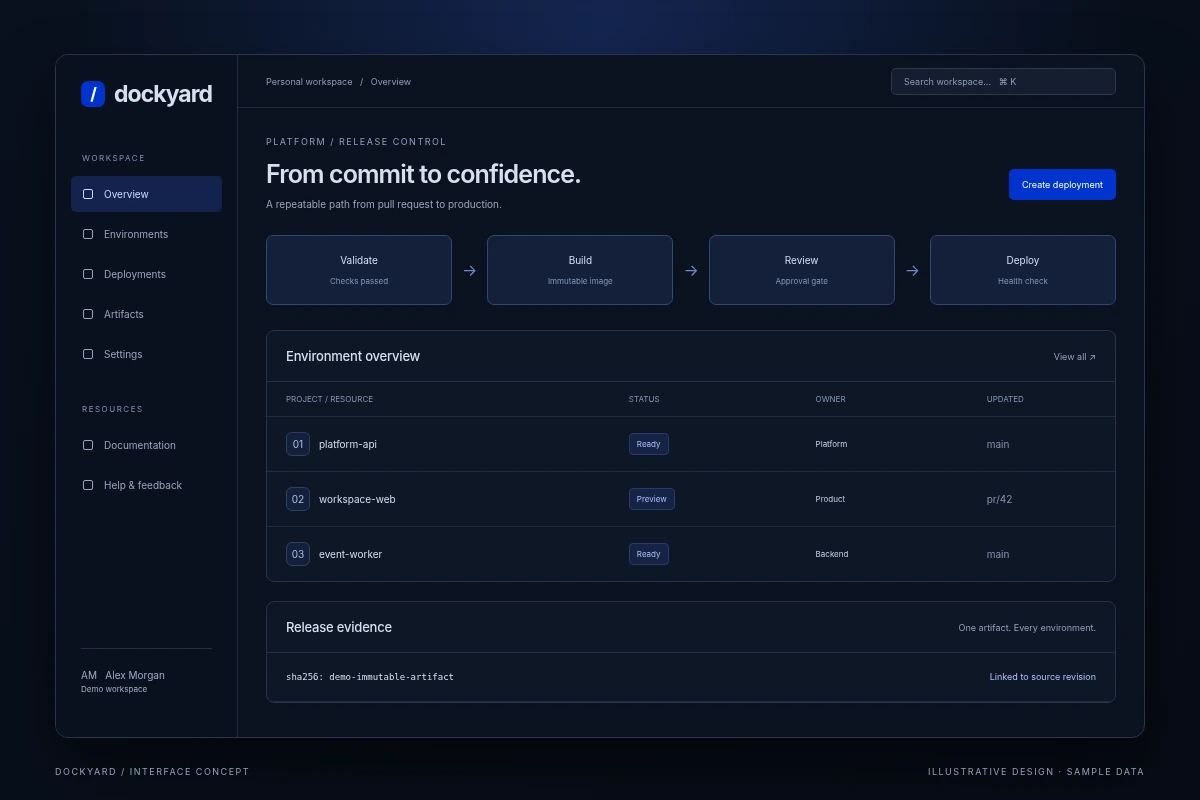
Dockyard is an internal-platform concept for teams that want a predictable deployment process without asking every product engineer to become an infrastructure specialist.
The interface focuses on the information a developer needs to act: which revision is running, which checks passed, what changed, and how to return to a known-good deployment.
The problem
Hand-written deployment steps create drift between environments. Missing release metadata slows incident investigation, while shared credentials make it difficult to establish who changed what.
A platform should reduce repetitive work, but it must not obscure the underlying system so completely that the team cannot debug it.
The solution
The proposed pipeline builds an immutable container image, records its digest, runs required checks and promotes the same artifact between environments. Deployment permissions are separated from application code permissions.
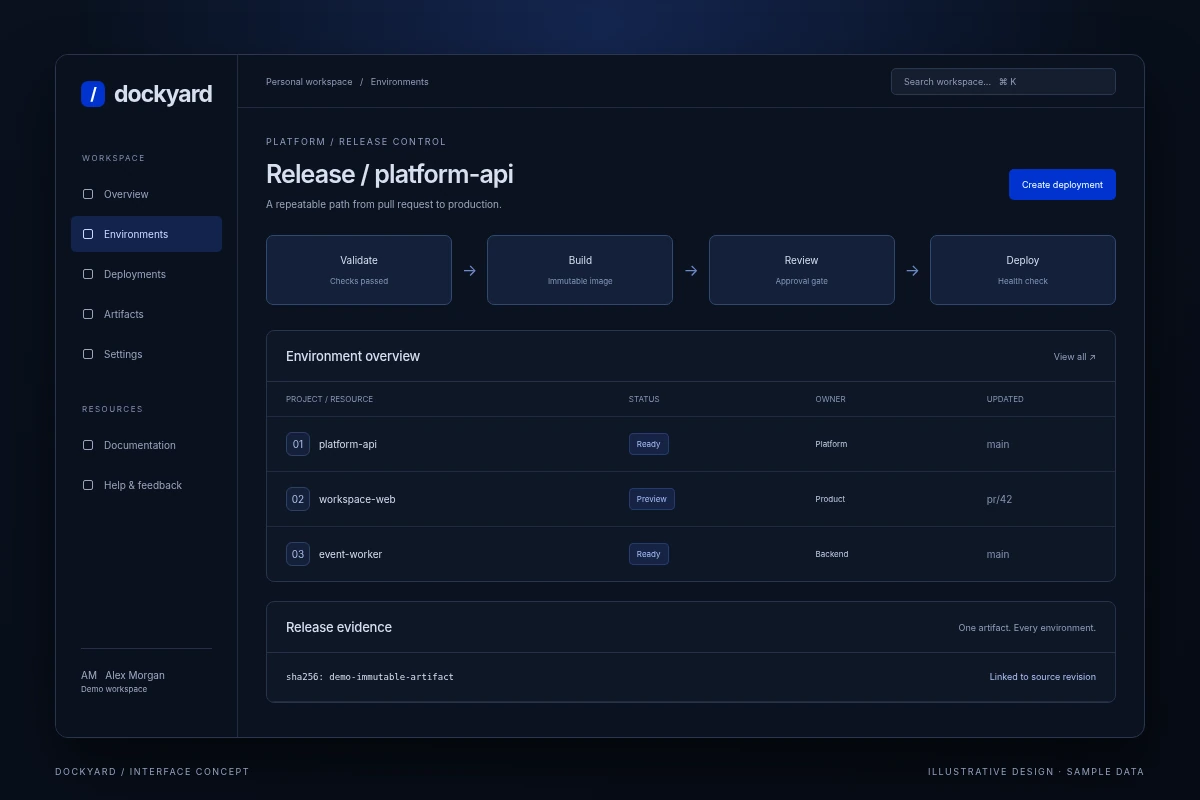
A small release dashboard links source revision, build evidence, health status and rollback guidance. The first version deliberately supports a limited application shape rather than an over-general platform abstraction.
Ownership, made explicit
My contribution
- Delivery design: define build, verification, staging and promotion as separate auditable stages.
- Runtime packaging: design container builds with pinned inputs, non-root execution and environment-specific configuration injection.
- Access boundaries: specify short-lived deployment credentials and scoped environment permissions.
- Operational UX: design release metadata, deployment status and a rollback runbook that an on-call engineer can follow.
- Ownership boundary: application-level business logic remains with the product teams; the platform owns the delivery path.
Architecture
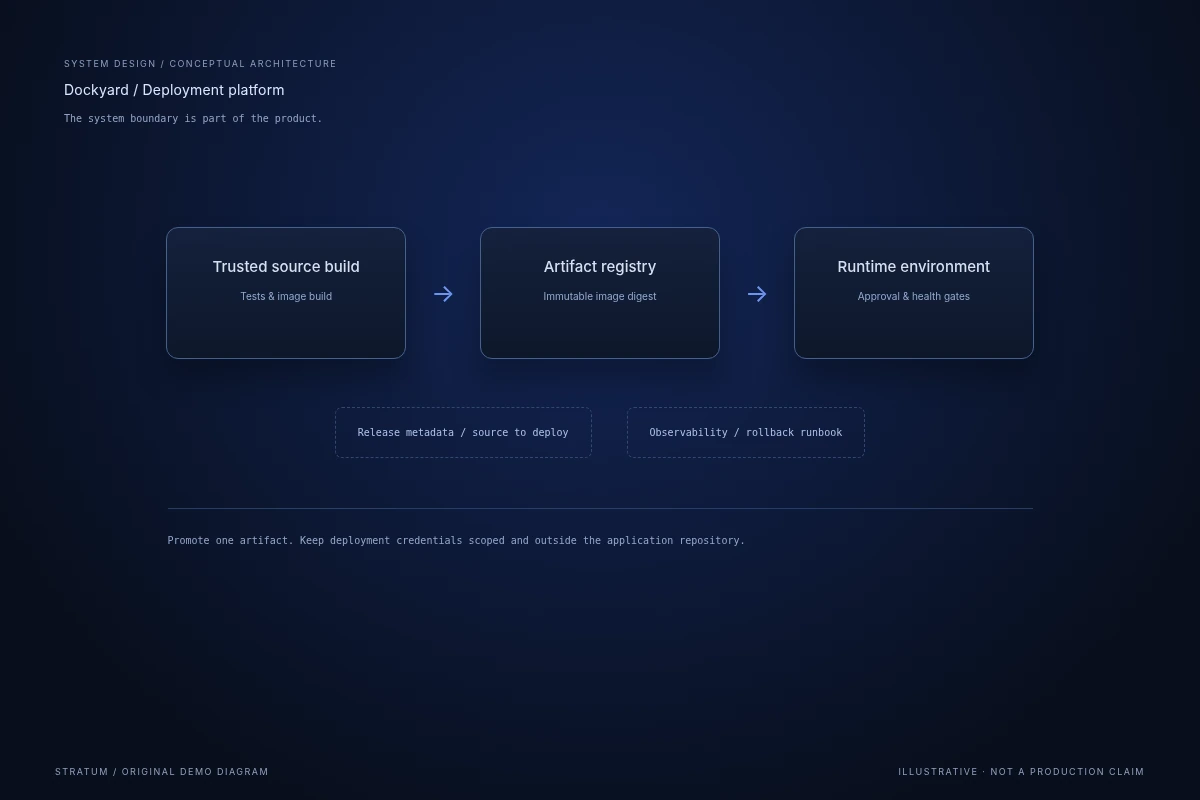
A pull request triggers validation. A trusted branch build publishes an image to a registry. The deployment job consumes its immutable digest and updates the target runtime after an approval gate.
Application telemetry feeds a health view that links back to the release. The exact runtime can vary; the stable interface is the artifact contract, configuration model and operational checklist.
Key features
Immutable release artifacts
One identified build is promoted between environments instead of rebuilding different code for each stage.
Preview environments
Short-lived application environments can support review, with clear ownership and cleanup rules.
Release traceability
Commit, checks, image digest and rollback notes are visible together.
Challenges & trade-offs
A green pipeline is not proof that an application is healthy. Readiness criteria must reflect the application and a rollback must account for backward-incompatible database changes.
A useful platform balances standardisation with escape hatches. Supporting too many deployment patterns in the first version would make the platform harder to operate than the manual process it replaces.
Results & impact
The concept produces a delivery workflow, dashboard screens and an operational handover outline. It demonstrates the engineering decisions that should precede any claim of faster deployment.
Deployment frequency, change failure rate and recovery time are left unclaimed until a real system supplies a comparable baseline.
Screenshots
Technology stack
Cloud infrastructure and managed platform services.
DocumentationReproducible application builds and runtime environments.
DocumentationVersion control, code review and small, reversible changes.
DocumentationRuntime diagnostics and deployment automation.
DocumentationTyped application contracts and maintainable UI code.
Documentation