AI / Search/2026
Lens / Knowledge search
A retrieval-first search experience that keeps source evidence visible and access boundaries intact.
Illustrative case study, not a claim of client work or measured production outcomes.
Concept case study. Demo and repository links are intentionally omitted; replace this content with your own verifiable project and public links.
Context
Overview
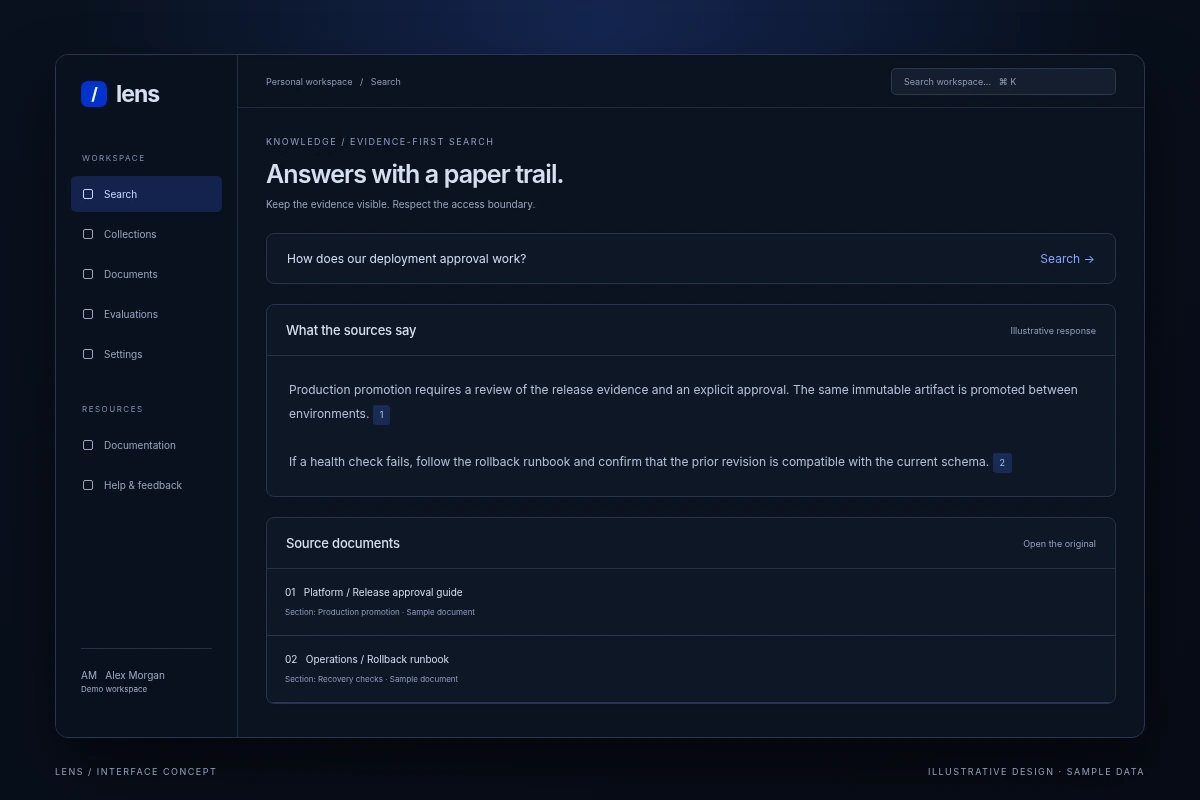
Lens is a knowledge-search concept for teams working across a growing collection of internal documentation. The interface is designed to help people inspect source material, not to make generated text look authoritative by default.
The case study describes a proposed retrieval pipeline and evaluation approach. It does not claim model accuracy or production adoption.
The problem
A fluent answer can be wrong, stale or based on a document that the current user should not see. A useful search product needs to expose its evidence, handle insufficient context and respect permissions throughout retrieval.
The system also needs an evaluation method that reflects the actual document collection rather than relying on a few hand-picked demonstrations.
The solution
The design applies access filters before retrieval results are returned. Documents are versioned, indexed in chunks with source identifiers and rendered as inspectable citations next to the answer.
The answer interface distinguishes retrieved evidence from generated synthesis. When evidence is missing, the product should say so and offer a conventional search path rather than fabricate confidence.
Ownership, made explicit
My contribution
- Ingestion: design versioned document records, chunk metadata and deletion propagation.
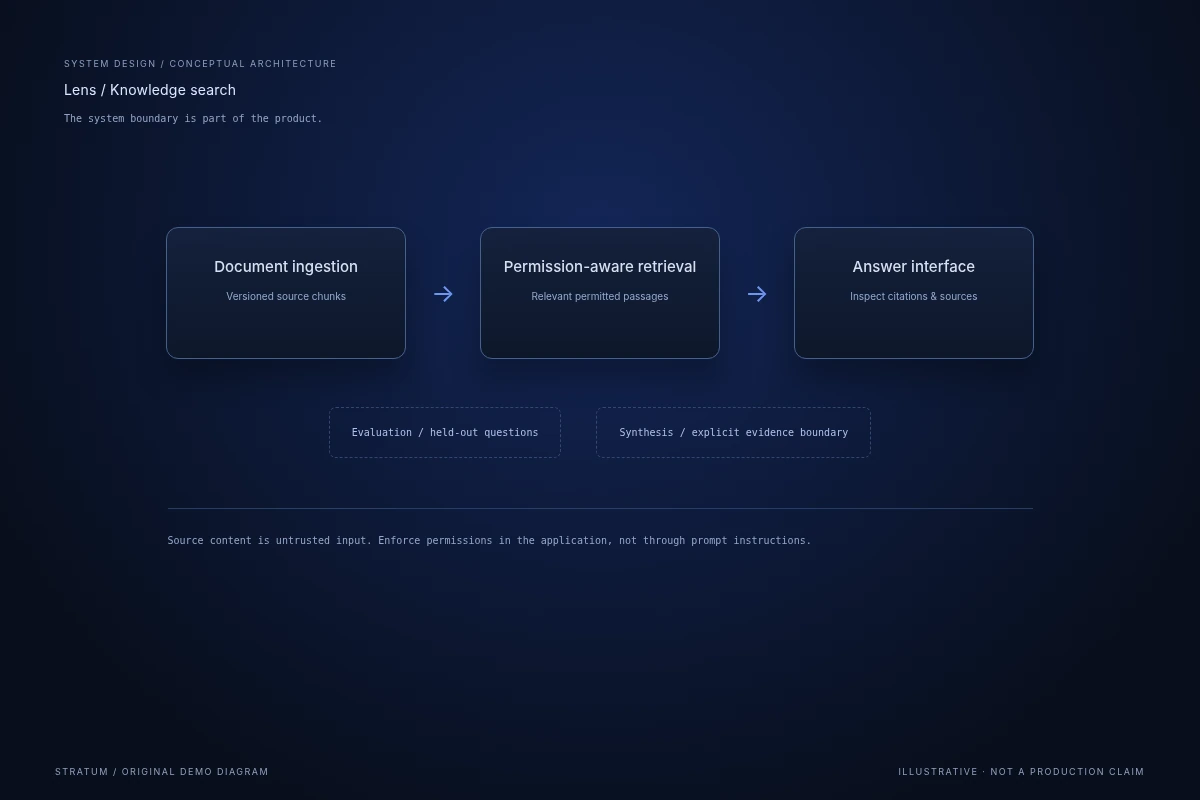
- Retrieval boundaries: enforce source access rules and keep permissions separate from prompt instructions.
- Product interface: build source previews, citation navigation and explicit insufficient-evidence states.
- Evaluation: propose a held-out question set, relevance labels and checks for citation support.
- Safety and privacy: treat retrieved documents as untrusted input and keep credentials and access control outside the model context.
Architecture
Documents pass through parsing and chunking into a searchable store. A request resolves the user context, retrieves permitted passages and optionally sends those passages to a synthesis service. The response retains source IDs so the UI can open the original material.
A separate evaluation path records retrieval relevance and answer support. Model choice is intentionally not hard-coded into the concept; data sensitivity and measured quality should guide it.
Key features
Evidence alongside answers
Readers can open the exact retrieved source instead of seeing an unsupported summary.
Access-aware retrieval
Permission checks are part of the application and retrieval layer, not a natural-language prompt.
Honest empty states
The interface can decline to synthesise an answer when relevant evidence is insufficient.
Challenges & trade-offs
Better retrieval does not automatically make every generated statement supported. Evaluation must inspect whether the answer is actually grounded in the cited passages.
Document freshness, prompt injection in source text and source deletion require application controls. Caching must include the relevant access context to avoid mixing users.
Results & impact
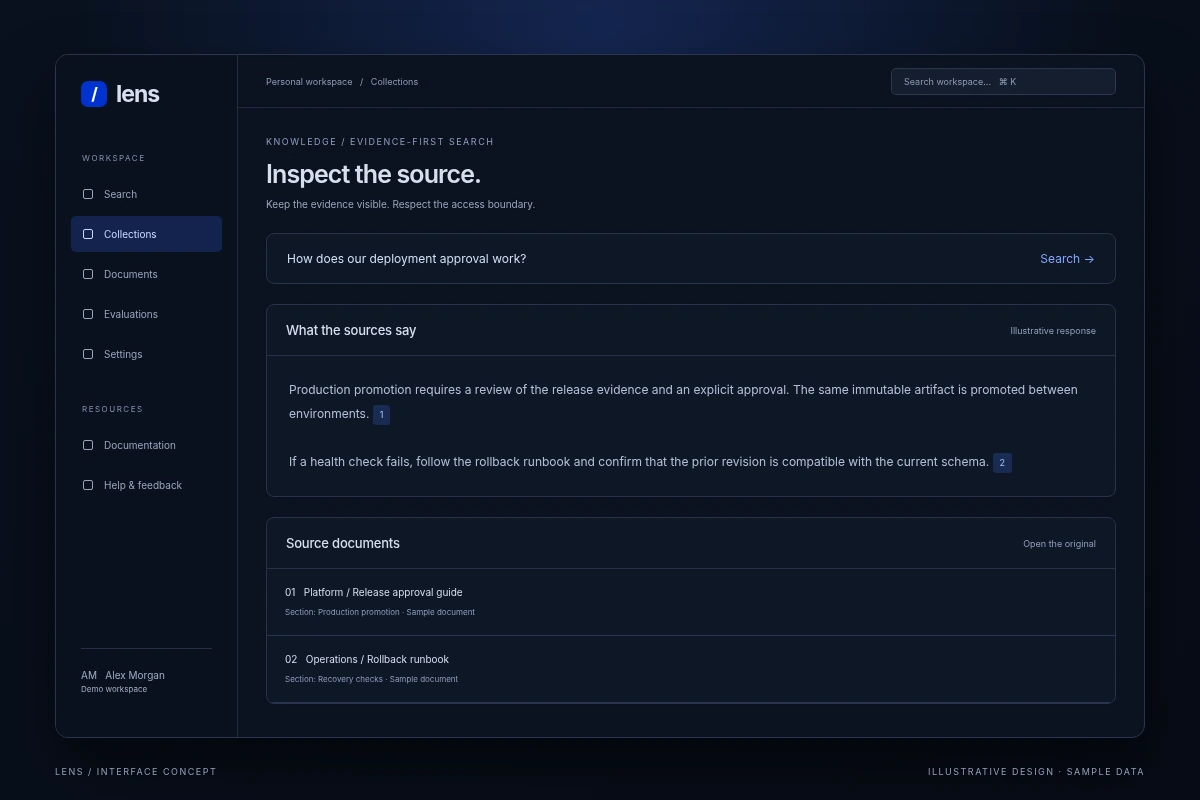
The concept documents an access-aware retrieval flow, evidence-oriented interface and an evaluation plan. The screenshots are product illustrations with sample documents.
Answer quality, latency and user benefit remain unmeasured in this demo. Real claims should be based on held-out evaluations and a clearly described operating environment.
Screenshots
Technology stack
Reproducible application builds and runtime environments.
DocumentationRelational modelling, transactions and query planning.
DocumentationData transformations, automation and retrieval services.
DocumentationComponent-driven interfaces and predictable client state.
DocumentationTyped application contracts and maintainable UI code.
Documentation